A majority of business travel buyers this year expect to
grow their air travel and lodging supply chains, prompted by increased travel
volumes and new travel patterns or destinations, according to Business Travel News research.
The February/March poll of 143 travel buyers also showed
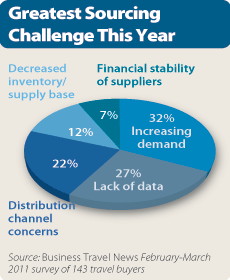
that increased demand is the top sourcing challenge for represented
organizations, cited by one in three respondents and compounded by rising
business travel prices, especially airfares and hotel rates.
Other top challenges named by survey respondents included a
lack of data (cited by 27 percent) and distribution channel concerns (22
percent).
 Travel buyers often complain that the data they receive from
suppliers and travel systems is less complete than they'd like. It's an ongoing
struggle and, along with cutting costs, provides the impetus for many sourcing
projects and program enhancements. These days, the quest for better data is
both complicated by and provoked by the issue of fees charged by airlines for
optional services.
Travel buyers often complain that the data they receive from
suppliers and travel systems is less complete than they'd like. It's an ongoing
struggle and, along with cutting costs, provides the impetus for many sourcing
projects and program enhancements. These days, the quest for better data is
both complicated by and provoked by the issue of fees charged by airlines for
optional services.
Optional services, including checked bags, seat assignments
and inflight Wi-Fi, also are a main element of buyer concerns around
distribution channels. Those concerns surface periodically as agreements
between airlines and global distribution system operators come up for renewal.
This year, discussions between some carriers and GDSs again are coming to a
head as current deals wind down and airlines attempt to make good on efforts to
more closely control their product distribution.
Beyond the familiar question of whether airlines would be
compelled to offer in GDS channels all fares—notably their lowest ones—the two
sides now are determining if, how and under which economic terms optional
services would be offered through GDSs. Some airlines appear bent on providing
at least some only through their direct channels.
Buyers, therefore, worry that their organizations' travelers
may not always have the opportunity to buy some of those optional services. And
if they do, the purchases may be transacted outside of approved travel
management processes, fragmenting not only content but also spending data.
A bigger problem is the complete withdrawal or ejection of a
carrier's fares and inventory from a distribution channel as a result of a
commercial and/or legal dispute. At press time, that was the case at Orbitz for
Business; American Airlines in November 2010 terminated its Orbitz
relationship, and OfB clients now require telephone calls to American to book
tickets on the carrier. Though not as extreme in its ramifications, biasing by
a distributor against a supplier in its system could make it more difficult for
that supplier's corporate accounts to book tickets through that distributor.
Overcoming Tight
Hotel Availability
Though hotel companies also have tangled with distributors,
those flare-ups have been far fewer in number. Travel buyers instead worry
about hotel availability.
"When local occupancy rates reach 85 percent or more,"
Carlson Wagonlit Travel in a first-quarter report recommended that corporate
travel programs add "one or two more local properties into the program.
While this requires engaging in the request-for-proposals process outside of
the typical negotiation season, it is a critical step to ensure availability of
supply at negotiated rates.
"New entrants to a program may have an incentive to
compete harder on price and service, even in high-demand markets, in an attempt
to earn a permanent place in the program," CWT continued. The travel
management company added that "there will be times in high-occupancy
markets when the negotiated rate is unavailable because rooms in the approved
category of service have sold out, or because the entire property is full.
Travel policies should provide clear guidelines to direct traveler behavior in
these situations, including specifying city rate caps, which are reasonable
per-night spending limits for selecting appropriate properties outside the
hotel program."
Perhaps at least partly because of limited availability in
key markets, the hotel segment was the business travel component in which
buyers polled by BTN were most likely
to indicate a growing supply chain.
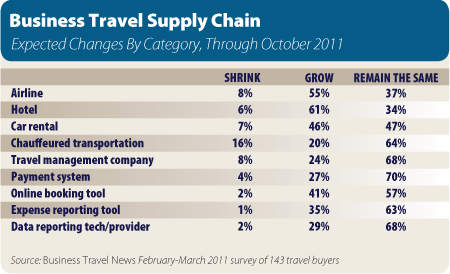 More than 60 percent of respondents expected to work with a
larger number of hotels in the coming year, while 6 percent anticipated a
decline. Of those expecting their hotel supply chain to grow, 73 percent
indicated that one reason was increased business travel volumes. Slightly more
than half cited new travel patterns and/or destinations.
More than 60 percent of respondents expected to work with a
larger number of hotels in the coming year, while 6 percent anticipated a
decline. Of those expecting their hotel supply chain to grow, 73 percent
indicated that one reason was increased business travel volumes. Slightly more
than half cited new travel patterns and/or destinations.
The second-most cited area in which survey respondents
indicated a growing supply chain this year was airlines. As in the hotel
category, the top reasons for the growth were increased travel volumes and new
travel patterns or destinations.
According to a March report from AirPlus International,
merger and acquisition activity among airlines—as well alliance-building and
development of joint ventures—has led buyers to reconsider their preferred
carrier portfolio.
"The airline category has been extremely volatile in
recent years, and negotiation patterns seem to reflect that activity," the
report stated. "Amid all these changes, travel managers have to wonder if
they are aligned with the right carriers from year to year."
Meanwhile, in an AirPlus February/March survey of 128
managed travel professionals, 55 percent of respondents indicated their
organizations have in place "multiple-year" deals with preferred
airlines. The remainder indicated their organizations have one-year contracts (26
percent), deals "as needed" (10 percent) or no preferred arrangements
(9 percent).
For the car rental segment, 46 percent of respondents to the
BTN poll said their supply chain in
that area would grow this year (with increased travel volumes and new travel
patterns or destinations again listed as the top factors). About the same
portion expected no change. When asked in which categories they intended this
year to begin "a major sourcing initiative," about 28 percent of
respondents mentioned car rental, the third-highest response behind airlines
and, unsurprisingly, hotels, which each came in above 40 percent.
According to the AirPlus report, decisions by car rental
companies to levy no-show fees and other new charges "could have triggered
a more active RFP season ... but moves to implement such charges fizzled."