A large majority of buyers still eschew dynamic pricing in
their hotel programs, according to Business
Travel News research, though some are reporting success through limited
arrangements. One major hotel chain, meanwhile, recently has completed an
initiative to make dynamic pricing more palatable to large-market buyers.
Almost two-thirds of 221 travel buyers surveyed by BTN said they did not use dynamic
pricing—a discount off the hotel's best available rate, rather than fixed
negotiated rates—in their hotel program. While the dynamic pricing model long
has been accepted on the airline side, the lack of transparency in hotel
pricing has been the biggest stumbling block to widespread acceptance on the
hotel side, said Bob Brindley, vice president of BCD Travel consulting unit
Advito.
"The global distribution systems have an official
clearinghouse for the air rates, and they have access per agreements with
carriers to their actual lowest rates," Brindley said. "Even though
hotels are guaranteeing the lowest rate if it's through their website, they can't
guarantee it through other channels."
Even so, Brindley said dynamic pricing does have a place
within a hotel program. He's seeing more buyers move to chainwide discounts,
combined with implementing market-specific rate caps, while still negotiating
rates in their top markets. The chainwide discounts can cover hotel stays in
low-volume as well as high-occupancy markets in case all preferred properties are
sold out, he said.
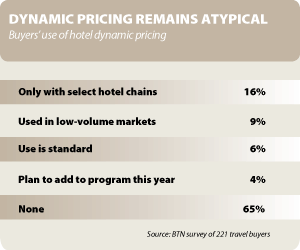 While only 16 percent of buyers said they use dynamic
pricing with select hotel chains, and only 9 percent said they use dynamic
pricing in low-volume markets, some buyers said they've driven additional
savings to their hotel program by adding a dynamic pricing component.
While only 16 percent of buyers said they use dynamic
pricing with select hotel chains, and only 9 percent said they use dynamic
pricing in low-volume markets, some buyers said they've driven additional
savings to their hotel program by adding a dynamic pricing component.
Cynthia Shumate, director of travel services for Estée
Lauder Cos., said this year she used dynamic pricing to tackle numerous U.S.
markets of 50 room nights or less. Shumate looked at the data for those markets
to determine which hotels travelers were frequenting the most and leveraged her
relationships with global account managers to get a discount off those
properties' best available rate.
By doing so, Shumate said travelers gravitated to those
hotels, now marked as preferred, and some even gained sufficient volume for
Shumate to target them for negotiations this year.
"I was not a huge proponent of dynamic pricing when it
first came out, but this particular application has a lot of value for me,"
Shumate said. "We were too filtered out among too many players, so we put
the stake in the sand and let the travelers do the right thing. It serves as a
progressive strategy."
Similarly, Sapient global travel manager Michelle de Costa
said she used chainwide dynamic pricing to supplement her flat-rate
negotiations. "It's worked out really well for us," she said. "People
like the idea of identifying with a chain, and it's pulled more people into our
program."
Historically, buyers have resisted hoteliers' push for the
use of dynamic pricing on a larger scale. This year, however, InterContinental
Hotels Group is urging large buyers to adopt dynamic pricing in 2011 hotel
programs through a training and communication plan it launched with its
national sales team.
"We want to take dynamic pricing, put it in the proper
box, wrap it up and put a bow on it," IHG senior vice president of
worldwide sales Stephen Powell said. "This is about the large global
accounts, and we're sitting down and having high-level conversations with them."
Powell said IHG's new approach includes a workbook and
technology tool to show buyers potential value in accepting dynamic rate. The
sales team also is trying to address common buyer criticisms of dynamic
pricing, such as the difficulty it presents in budgeting.
"In our value proposition, we think we can predict with
greater accuracy because we have the history," he said. "It's what we're
already doing, because with fixed rates, we're predicting what average daily
rates are going to be in 2011. If we can get close to what ADR is going to be,
it can help in future budgeting."
IHG also wants to use dynamic pricing to continue to be
favorable to companies that provide large volumes to its hotels, he said. "As
you continue to give us more business," Powell said, "the more valued
rate you would get."
Powell said discussions with large corporations also are
including hybrid dynamic pricing models similar to Shumate's and de Costa's
approach, in which high-volume locations with thousands of room nights continue
to have fixed rates while locations with lower volumes have dynamic pricing.
Advito's Brindley said most of his clients would continue
with the standard approach to hotel rates, though as more buyers try dynamic
pricing on secondary markets, they might consider it on a wider basis down the
road. "They won't take a dive into the unknown, but based on a successful
hybrid program, they could go all-in for the dynamic model."
Sapient's de Costa said she planned to continue with her
dynamic pricing model for secondary cities in 2011. Estée Lauder's Shumate said
she was considering expanding her program to Canada and Europe, the Middle East
and Africa based on its success in the United States.
IHG's Powell said more widespread dynamic pricing could make
the arduous hotel rate negotiation process easier. Dynamic pricing, for
example, would allow buyers to enter more easily into multiyear contracts
rather than having to negotiate fixed rates every year, he said.
"In 2009, there was lots of tendering and retendering,"
Powell said. "If you consider the return on investment in that process,
what did it cost them to have to stop everything to do that?"
This report originally
appeared in the Sept. 6, 2010, issue of Business Travel News.