A quickly evolving corporate meetings market, marked by what
hoteliers and analysts are characterizing as swelling worldwide demand, not
only promises higher costs--though not necessarily immediately--but also calls
into question the fate of the tighter meetings policies many corporations
enacted in the wake of the 2008 economic recession.
Several large hotel companies boasted strong first-quarter meetings performance: Group requests for proposals rose 20 percent at Omni
Hotels & Resorts, in-quarter bookings increased 15 percent at Hyatt Hotels
Corp., and corporate group business jumped 35 percent at Starwood Hotels &
Resorts. Even at Marriott International, where first-quarter group business was
weaker than expected, group bookings were trending 10 percent higher for the
remainder of the year.
"We started seeing the return of demand, in terms of
bookings, in the fourth quarter of 2010, and it's come back quite strong since,"
said Greg Malark, COO of site-selection firm HelmsBriscoe. "There's not as
much demand in the market as there was in 2008, but we are approaching that
threshold."
Many buyers expected their companies to spend more on
meetings this year than they did last year, according to a BTN March-May survey of 127 corporate travel buyers. About 63
percent of those respondents foresaw higher 2011 meetings spending, and nearly
half of them projected increases of at least 10 percent.
Even buyers whose companies planned no increase in meetings
volume should expect higher costs, analysts said, as overall demand growth
slowly is beginning to strengthen hoteliers' negotiating hand. However, with
many of the growing number of booked meetings not scheduled to take place until
later in 2011 or beyond, many hotels have meetings availability. Though a low
level of full-service convention hotel construction during that period offsets
some of that, there is availability especially for short-term meetings.
"There's a much quicker negotiating period than there
has been in the recent past," said BCD Meetings and Incentives president
Scott Graf. "There's a feeling of, 'You can help me in this particular
instance or you can't. No hard feelings, but if you can't help me find value, I'm
going to go to the next option. Not the next option down, but the next option.
Whether I'm dealing in the upscale, midscale or lower, there are plenty of
options.' "
Still, that short-term availability and flexibility will
dissolve by the beginning of 2012 as new bookings turn into actual occupancy,
HelmsBriscoe's Malark said. "In the last three or four months average
rates for meetings have started to go up, albeit very slowly. We're also seeing
hotels being less flexible," he said. "Some of the offers in 2008 and
2009, like zero attrition, a lot of that's gone. It's still very much a buyer's
market, but it seems like we'll have slow rate growth over a number of months.
It won't all of a sudden be 2007. We're still booking on average $25 less [per
room] than we were in early 2008."
Growth in demand and rate increases aren't limited to the
United States. Ian Quartermaine, CEO of online site-selection firm MeetingsIn,
described meetings demand in Asia/Pacific as "complete bedlam." He
observed that demand in the region "is primarily driven out of mainland
China, with a little from India. Rates will grow steadily, but no massive
increase. What will hold it back is the massive increase in capacity. We see
North America more steady with Europe much slower, especially the United
Kingdom."
Policy Implications
Malark attributed the rise in demand in part to corporations
returning to traditional patterns by re-establishing meetings held in 2007 and
2008. Since that time, many companies created or strengthened policies that
restricted or forbade some external meetings. As the economic rebound takes
hold, it is unclear whether, and to what degree, corporations will relax those
policies.
"I definitely see a relaxation of policies in favor of
guidelines," said Cvent vice president of enterprise sales Anil Punyapu,
adding that he sees corporations de-emphasizing policies that require
pre-booking approval by certain executives in favor of post-event audits. "You'd
need approval, but not in a structured way, where only a certain person can
approve it. When you are tracked and audited and someone else is watching, you're
going to be a better citizen and less likely to do something."
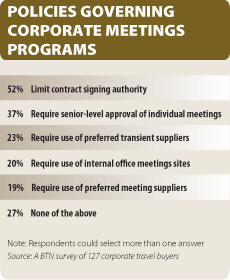 Thirty-seven percent of respondents to the BTN survey indicated their companies
require senior-level executive approval to hold individual meetings, the most
frequently cited policy plank other than contract-signing authority, which more
than half of respondents said their companies limit.
Thirty-seven percent of respondents to the BTN survey indicated their companies
require senior-level executive approval to hold individual meetings, the most
frequently cited policy plank other than contract-signing authority, which more
than half of respondents said their companies limit.
Any policy that allows for more control over site selection
is a candidate for strengthening, potentially leading to better negotiated
supplier deals, said StarCite vice president of enterprise strategy Kevin
Iwamoto. "There have been a lot of companies that have redone their
policies, including mature companies who had a program in place," he said.
"They've made it more comprehensive and built in more consequences. Like
any good category manager, you set up the program, create the policy and start
tracking. Based on the metrics, as the program matures, you redefine the
program, policy and metrics."
One in five BTN
survey respondents indicated their companies have policies requiring the use of
preferred meeting suppliers, slightly less than those whose policies direct
meetings to preferred transient suppliers.
Some new policies include more specific language concerning
when meetings must be held via remote conferencing instead of in a face-to-face
environment, Iwamoto said. "Some companies are directing that," he
said. "You fill out a profile of the meeting, and you're directed to book
the meeting online or through telepresence instead of a trip."